

This article was originally published by Environment Journal on July 13, 2026
By Suha Jethalal
It’s important to talk about climate competitiveness in Canada, an issue that is increasingly central to Canada’s future, even if our conversations about it are sometimes still stuck in older patterns.
Part of the challenge is how we frame the issue.
I come from a strategy and marketing background, and when I first started working in the environmental sector in 2009, I was focused on inspiring Canadians to care about the effects of climate change. We did that using data and hopeful and emotionally compelling messaging.
At the time, the challenge was lack of awareness.
Many people did not fully understand climate change, questioned its legitimacy, or viewed it as distant and abstract. As awareness rose, climate communication evolved to depict dire detriments of lack of action to build a sense of urgency, to break through apathy, and to encourage voluntary action that could eventually build pressure for broader policy change.
And in many ways, it worked for a while. But there was also an unintended consequence. The more successfully we communicated the scale of the crisis, the more people internalized a sense of helplessness.
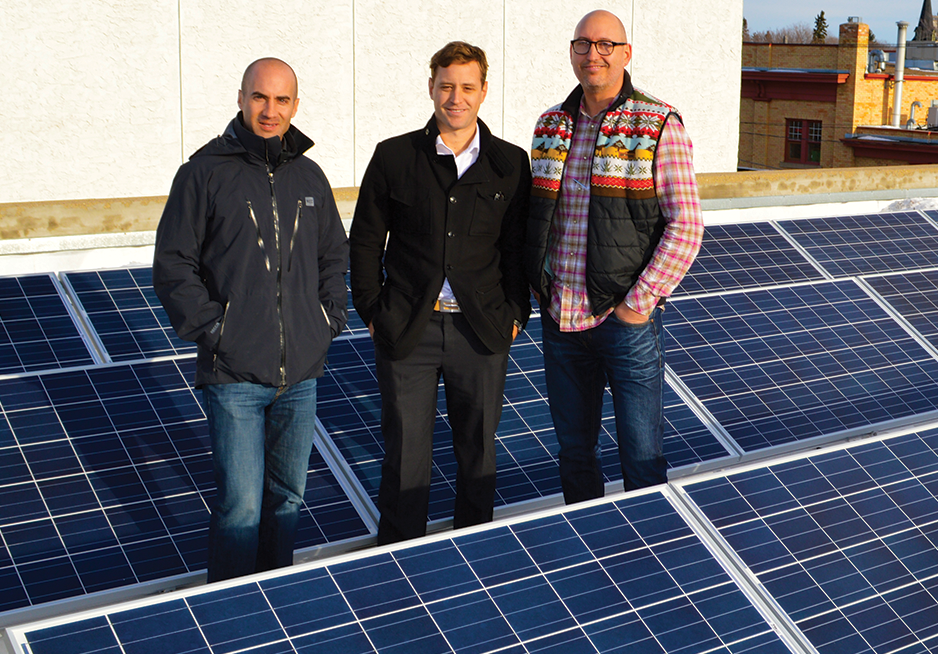
Even though Saskatchewan is Canada’s sunniest province—it has very few solar projects. A local Saskatoon theatre, its solar project and local community leader, Kirby Wirchenko are changing this. Wirchenko, the Executive Director of the Broadway Theatre, championed the idea to install an 88-panel solar array on the Theatre—an historic building originally built in World War II for veterans. Today, more than 50 per cent of the building is now powered by renewables, demonstrating that solar is powerful, plentiful and within reach in Saskatchewan. Bullfrog provided financing for the project.
Now, Canadians already understand that climate change is real. What they are less certain about is where they fit into the solution.
This shift matters because the nature of climate action itself has changed. A decade ago, climate action was unplugging chargers, recycling more carefully, avoiding plastic waste in water streams, switching lightbulbs.
Today, we are talking about rebuilding major parts of the operating system of the economy itself while protecting biodiversity. Rebuilding electricity systems, transportation networks, industrial supply chains, data infrastructure, and capital markets changes the conversation.
An important evolution in climate communication is moving: from fear to agency, from sacrifice to participation, from individual guilt to collective momentum, from catastrophe narratives to transition narratives, and from “why this matters” to “how we move forward.”
Climate action is no longer just an environmental discussion; it is becoming an industrial competitiveness discussion.
The countries that build affordable, reliable, low-carbon electricity systems fastest will attract the next generation of investment. Electricity is becoming the new economic platform.
Climate competitiveness increasingly comes down to three things: speed, electricity, and execution.
- How quickly can you build?
- How sustainably and affordably can you power growth?
- And how effectively can you move capital into real infrastructure?
Canada has advantages here. We have abundant natural resources, the potential to be the cleanest electricity system in the world, strong engineering talent, deep institutional capital, and growing expertise across clean technology, storage, environmental finance, and electricity markets.
But advantages only matter if they are operationalized. And the world is moving fast.
If we step back from the political noise for a moment, the scale of change already underway is remarkable.
In 2020, electric vehicles represented roughly four per cent of global vehicle sales. Today, they are approaching 30 per cent. That is a market transformation.
Solar is now one of the fastest-growing sources of new electricity generation globally.
Battery deployment is accelerating at a pace that has fundamentally changed how utilities and grid operators think about reliability and system planning.
Globally, roughly $2 trillion per year is now flowing into clean energy and clean technology.
The risk for Canada is not that the transition fails to happen; the risk is that it happens faster elsewhere. And this matters because Canada’s electricity demand is about to grow significantly.
Electricity demand will rise by at least 40 per cent by 2050 and potentially much more in a heavily electrified economy. Prime Minister Mark Carney’s new Electricity Strategy plans to double grid capacity by 2050 as transportation, heating, manufacturing, AI infrastructure, and data centres are all increasingly converging onto the grid simultaneously.
We are already seeing the early signs. British Columbia recently issued a major call for power as electricity demand accelerates. One proposed AI data centre alone could require roughly 150 megawatts of electricity capacity, enough to power 150,000 homes. We used to think data lived in the cloud. Now we are learning the cloud has a costly utility bill. Recent drought conditions have reduced hydroelectric reservoir capacity in parts of the country, forcing increased electricity imports during certain periods.
Climate volatility is no longer separate from economic planning, but rather, it is becoming embedded within it.
This means future competitiveness will depend not only on how much electricity we generate, but also: how quickly we expand transmission; how effectively we deploy storage; how flexible and/or resilient the grid becomes; and, how efficiently provinces coordinate infrastructure planning.
In many ways, this is now a nation-building exercise.
Here in Canada, permitting timelines, transmission approvals, interconnection queues, and infrastructure coordination are often moving too slowly relative to both technology cycles and investment cycles.
But I am very hopeful by what is possible. Transitions can move in cycles: acceleration, resistance, adjustment, and continuation.
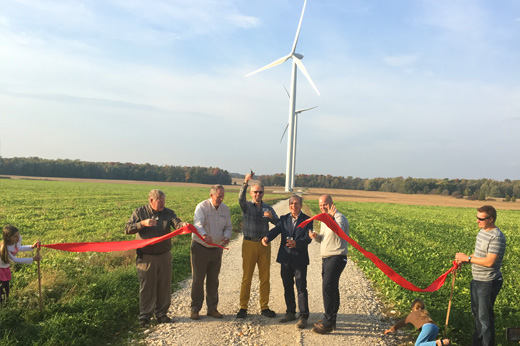
The ribbon cutting for the Gunn’s Hill Wind Farm project in Oxford County. Ontario’s first community-owned wind farm is the result of a collaboration of Oxford Community Energy Co-op (OCEC), the County, the Six Nations of the Grand River, developer Prowind Canada Inc. and Bullfrog. The 18 MW project is now generating enough clean, renewable electricity to power more than 6,000 homes in the county.
We are living through one of the adjustment phases now. But the underlying economic drivers continue moving in the same direction: renewables continue scaling; battery performance continues improving; electricity demand continues growing; and capital continues flowing into clean infrastructure globally.
Increasingly, businesses are adapting as well.
At Bullfrog Power, part of our work involves helping organizations navigate evolving environmental markets and sustainability procurement. But one of the biggest issues emerging in these markets today is trust. As carbon markets and environmental claims expand, scrutiny around greenwashing, verification, and reporting integrity has increased significantly.
We have just launched environmental tokens—digital environmental attributes associated with energy-related emissions reductions and nature-based solutions with embedded metadata that create traceable and verifiable records.
When environmental attributes become more measurable, auditable, and transferable, markets become more efficient. And when markets become more efficient, capital scales faster into real infrastructure and real outcomes.
That is how systems begin to shift. Not through isolated individual actions alone, but through millions of decisions across procurement systems, infrastructure investments, supply chains, capital allocation, and institutional planning.
For me, this has also become deeply personal. I have now spent nearly two decades working in and around this space. And one of the biggest things I have learned is that large-scale change rarely arrives all at once. It happens gradually. Then suddenly.
You see it in technologies that once seemed unrealistic and are now mainstream. You see it in businesses that once treated sustainability as peripheral and now treat it as core strategy, built in product sets. And you see it in younger generations entering the workforce with very different expectations about what the future economy should look like.
For years, climate conversations were framed primarily around limitation: what we would need to give up, what we would need to reduce, what we would need to stop. But increasingly, this is becoming a conversation about what we can build sustainably. The countries that move fastest will help define the next industrial era. Canada has the assets and resources to lead and set an example for the rest of the world.