

As more businesses work to demonstrate credible climate leadership, independent, third-party certifications like B Lab’s B Corp certification are becoming increasingly important. Under the recently updated B Corp standards (Version 2.1), climate action has been introduced as a core requirement, with specific priorities tailored to a company's size. For larger organizations, there's emphasis on measuring and reducing greenhouse gas (GHG) emissions across Scope 1, Scope 2, and Scope 3.
A credible, science-aligned climate strategy has to address all three scopes. Understanding each scope’s unique role is key: direct emissions (Scope 1), purchased electricity (Scope 2), and the harder-to-track impacts across the value chain (Scope 3) all contribute differently to an organization’s overall footprint and require their own approach. That’s where Bullfrog Power can support businesses by providing renewable electricity, green natural gas, and carbon offset solutions that help organizations take meaningful action across their full emissions profile.
What the new B Corp Impact Topics mean for businesses
As part of its evolving standards, B Lab introduced a new structure built around Impact Topics—key areas where companies must demonstrate measurable progress.
These topics move away from a flexible, points-based system toward mandatory performance requirements, ensuring all certified companies meet a consistent baseline of social and environmental impact.
The updated Impact Topics include areas such as:
- Environmental Stewardship
- Human Rights
- Fair Work
- Justice, Equity, Diversity and Inclusion
- Governance
Together, they reflect a more rigorous and holistic approach to business impact. For companies, this means going beyond commitments to show credible, transparent action, particularly when it comes to climate.
Understanding the climate requirements in B Corp certification
Historically, B Corp certification evaluates a company’s social and environmental performance across several categories, including governance, workers, community, environment, and customers. Under the latest standards, climate action is embedded more deeply than ever, aligning closely with globally recognized frameworks like the Greenhouse Gas Protocol and the Science Based Targets initiative (SBTi).

To meet these expectations, companies are encouraged to:
- Measure and disclose their GHG emissions
- Set science-based targets aligned with global climate goals
- Actively reduce emissions across their operations and value chain
Within this framework, emissions reductions follow a clear mitigation hierarchy:
- Avoid and reduce emissions wherever possible
- Switch to renewable energy
- Address remaining emissions through credible offsets
Supporting your GHG emissions strategy with Bullfrog Power
Each emissions scope requires a different approach, and together they form a complete picture of a company’s emissions impact.
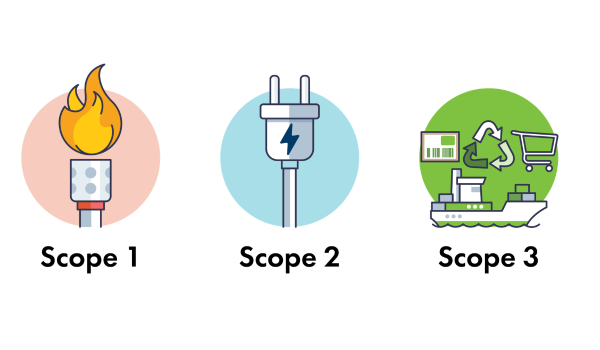
Scope 1: Direct emissions
Scope 1 includes emissions from on-site fuel use, such as heating or industrial processes. Solutions like Bullfrog Power’s renewable natural gas can help lower the carbon intensity of these activities, supporting near-term reductions while companies pursue longer-term strategies like efficiency improvements and electrification.
Scope 2: Purchased or acquired electricity
Bullfrog Power’s green electricity solution helps address Scope 2 emissions by matching your electricity use with high-quality renewable energy certificates (RECs). To help promote renewable energy development in your community, we source 50% of RECs from your region (including carbon-intensive grids) and the rest from other Canadian regions. Organizations purchasing larger volumes can work with us to develop a customized REC mix to reflect the provinces where the energy is being consumed.
Scope 3: Value chain emissions
Scope 3 emissions cover everything upstream and downstream of your own operations. From suppliers, logistics, business travel, product use, and end-of-life disposal, the data must be collected from dozens or even hundreds of third parties, many of whom don’t track of share emission data consistently. While often the most complex to address, companies can take meaningful steps by engaging suppliers, improving procurement practices, and using high-quality carbon offsets to address emissions that cannot yet be eliminated.
We exclusively provide ICROA-endorsed carbon offsets, ensuring robust quality standards and environmental integrity. These are supported by voluntary annual audits that safeguard against double counting of environmental benefits.
Advancing a science-based climate strategy
Acting across all three scopes is key to aligning with B Corp expectations and broader climate frameworks. Renewable energy and carbon solutions can play an important role by helping companies:
- Make measurable progress on emissions reductions
- Align with science-based targets
- Demonstrate credible, transparent climate action
These solutions are most effective when integrated into a broader strategy that prioritizes efficiency, operational changes, and long-term decarbonization.
Moving forward with flexibility and transparency
The businesses reaching their climate goals aren't waiting for perfect conditions — they're making progress now, scope by scope. B Corp certification is one way to stay accountable to that progress, ensuring climate action remains central to how an organization operates and evolves. By addressing Scope 1, Scope 2, and Scope 3 emissions, companies do more than reduce their footprint. They strengthen their foundation for whatever comes next.